

Adding a Passenger
Welcome to Week 4 of our Transitions Series in the Game of Life. Last week, we explored career transitions—when your job changes or when you outgrow the role you’re in. We talked about how work shifts can shake your identity and how to move forward with intention even when the path isn’t clear. This week, we’re looking at the transitions that happen when you add passengers to your journey: romantic partners, furry companions, children, or anyone else who becomes part of your daily life.
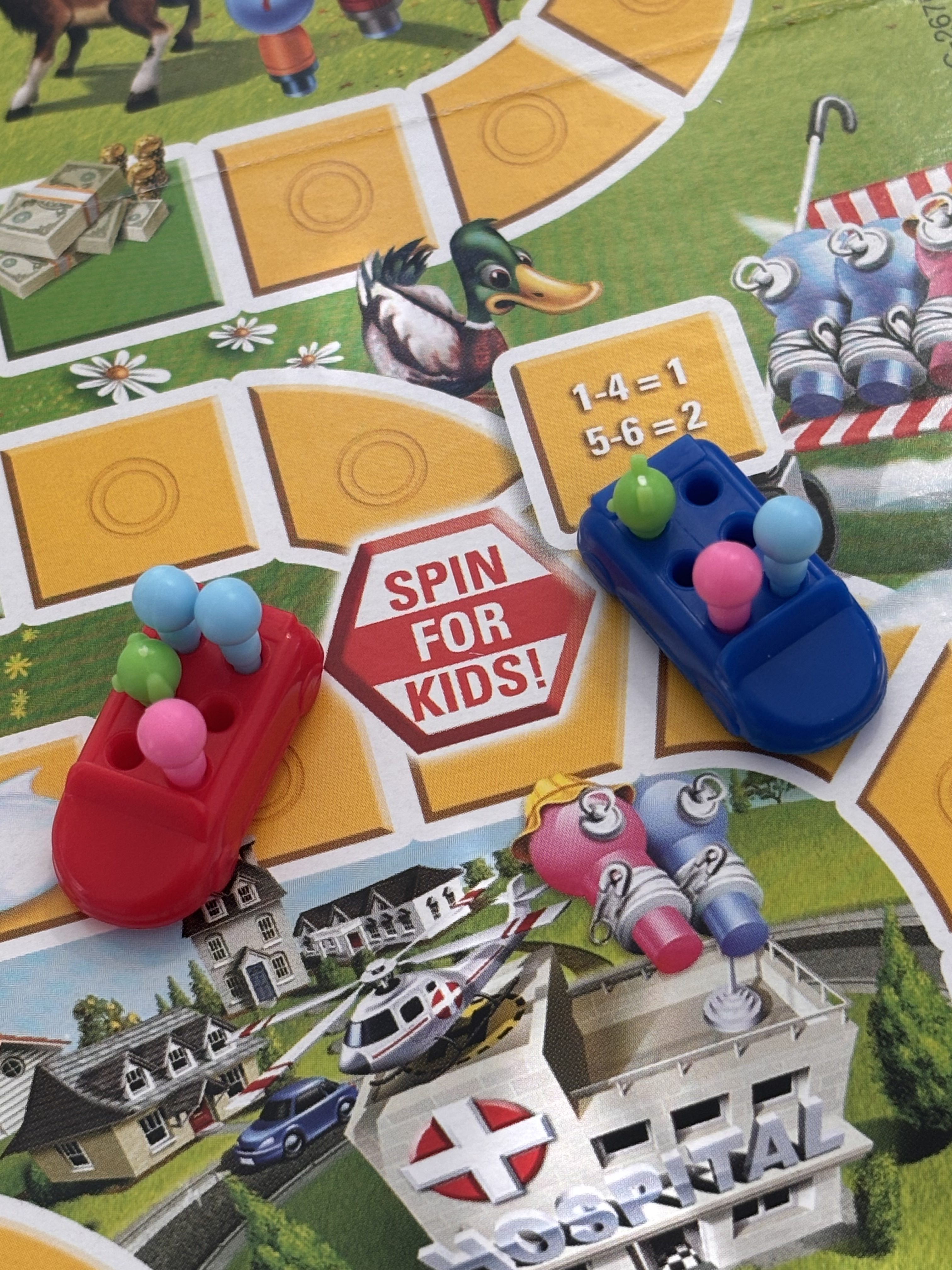
Remember in the Game of Life when you’d automatically get married at a certain point on the board, then later land on spaces that said “It’s a boy!” or “Twins!” and you’d just pop little pink or blue pegs into your plastic car? The game made it seem so linear, so inevitable: meet someone, get married, have kids. More passengers, more noise in the backseat, but the game continued pretty much the same.
Real life? Not nearly so predictable.
The game makes assumptions that don’t match everyone’s reality. Not everyone gets married. Not everyone has kids. Some people add a dog before they add a partner. Some build chosen families rather than traditional ones. Some find love after years of being single, or become parents without a partner, or create households that look nothing like what the game board suggests.
And here’s what the game definitely doesn’t capture: adding passengers to your life—whoever they are—fundamentally changes the journey. Your route shifts. Your priorities reorganize. Sometimes, you change so completely that you barely recognize the person you were before.
Let’s talk about what these transitions actually look like.
The First Passenger: When You Stop Being Solo

For many people, the first major “passenger” is a romantic partner.
Maybe it starts with dating—those early stages of getting to know someone, figuring out if there’s potential, navigating the vulnerability of letting someone see who you really are. Dating can be exciting, exhausting, hopeful, and disappointing all at once. You’re trying to stay open while also protecting yourself. You’re wondering if this could be something real or if you’re wasting your time.
And then, if it works, comes the transition into commitment. Moving in together. Getting engaged. Getting married. Becoming domestic partners. However you formalize it (or don’t), there’s a shift that happens when you go from “me” to “us.”
Suddenly, your decisions aren’t just yours anymore. Where you live, how you spend money, whose family you visit for the holidays, whether you get a dog, what color to paint the living room—all of it becomes a negotiation. Your space is shared. Your time is shared. Your life is no longer entirely your own.
Some people thrive in partnership. Others realize they prefer independence. And some discover that the person they committed to isn’t who they thought, and the relationship that once felt like the right path becomes something they need to leave.
The Breakup: When a Passenger Leaves

Here’s a transition the Game of Life never includes: breakups and divorce.
When a significant relationship ends—whether it’s dating, engagement, marriage, or a long-term partnership—you don’t just lose a person. You lose a future you’d imagined. You lose routines, traditions, shared friends, maybe even a home. You lose the identity of being someone’s partner.
If you were married, there’s the legal unraveling—dividing assets, navigating custody if there are kids, explaining to everyone why it didn’t work out. If you lived together, there’s the logistical nightmare of separating lives that had become deeply intertwined.
And there’s the grief. Even if you’re the one who ended it. Even if the relationship was toxic or unfulfilling. Even if you know it was the right decision. There’s still loss.
But here’s what can also be true: sometimes removing a passenger is exactly what you need to find yourself again. Sometimes the space that opens up when a relationship ends allows you to rediscover who you are outside of “we.” Sometimes the hardest transitions lead to the most profound growth.
The Four-Legged Passenger: Adding a Pet

Let’s talk about pets, because for many people, this is the first real taste of being responsible for another living being.
Getting a dog, a cat, a rabbit, a bird—whatever the creature—is a bigger transition than people often expect. Suddenly, you can’t just leave for the weekend on a whim. You have to come home to let the dog out. You have to arrange care if you travel. You have to budget for vet bills, food, unexpected emergencies.
And if you live with a partner, a pet becomes a shared responsibility that can reveal a lot about how you navigate partnership. Who gets up to walk the dog at 6 a.m.? Who’s cleaning the litter box? Who’s taking them to the vet? These small daily negotiations are practice for the bigger ones that come with kids.
Some people get a pet solo and build their life around that companionship. Some get a pet as a couple, testing the waters of shared responsibility. Some add a pet after they have kids, creating even more chaos in an already chaotic household. All of these are valid ways to explore life.
The Biggest Passenger: Becoming a Parent
And then there’s parenthood—the transition that rewrites everything.
In the Game of Life, you just add a peg and keep rolling. In real life, becoming a parent is one of the most seismic shifts you’ll ever experience. It changes your identity, your priorities, your relationships, your daily reality, your sense of self.
The Many Paths to Parenthood

The game assumes one path: marriage, then kids. But real life offers many routes to becoming a parent, and each comes with its own unique transition.
You might have a baby with your partner—through pregnancy, surrogacy, or IVF. You might adopt or foster. You might become a step-parent, entering a family that already exists. You might become a single parent by choice. You might co-parent with someone you’re not romantically involved with.
Each path is different, but the fundamental transition is the same: your life is no longer just about you.
What Nobody Tells You
There are realities about parenthood that people hint at but don’t fully prepare you for:
You might not feel instant love. Movies show parents gazing adoringly at their newborns, but sometimes you just feel overwhelmed. That connection can take time to develop, and that’s normal.
Your relationship with your partner will shift. You’re not just romantic partners anymore; you’re co-parents, tag-teaming through exhaustion, negotiating whose turn it is to handle the 3 a.m. wake-up. Some couples grow closer. Others drift apart.
You’ll grieve your old life. Even if you desperately wanted kids, you’re allowed to miss the freedom, the spontaneity, the uninterrupted sleep, the ability to be selfish with your time.
You’ll might even lose parts of yourself—hobbies, friendships, career momentum, the person you were before. And you’ll discover new parts: strength, patience, a capacity for love that surprises you, an ability to function on far less sleep than you thought possible.
The Career Collision
As we talked about in last week’s article on career transitions, parenthood often forces professional shifts whether you planned for them or not. Maybe your job isn’t flexible enough for the realities of parenting. Maybe childcare costs more than you earn. Maybe you thought you’d go back to work but can’t imagine leaving your child. Or maybe you thought you’d stay home but desperately need adult conversations and professional identity.
There’s no perfect solution. Working parents feel guilty for not being home more. Stay-at-home parents feel guilty for not using their other talents. Parents trying to balance both feel guilty for not doing either one fully. Whatever you choose, someone will probably judge you for it.
As They Grow
Here’s a transition we often fail to recognize so we can get support: the shift as your children get older and need you differently.
When they’re babies, you’re everything. As they grow, they develop independence. They make friends. They spend hours away from you. Eventually, they become teenagers who’d rather talk to friends than you. Then they become young adults who move out and build their own lives. Sometimes, not everyone will go. That can be its own transition, as seen in the movie “Failure to Launch”.
Your primary identity for years—maybe decades—has been “parent.” And now, gradually, your kids don’t need you the way they used to. The day-to-day intensity eases. The house gets quieter. Your calendar has space again.
And you’re left with a question you haven’t had to answer in a long time: Who are you when you’re not actively parenting?
Choosing Your Passengers (or Not)

We should also acknowledge that not everyone follows the traditional script.
Some people never get married and build rich, fulfilling lives solo or with a chosen family. Some choose not to have kids—and that’s a valid, intentional choice, not something that’s “missing.” Some want children but can’t have them, and the transition they’re navigating is grief for the family they won’t have.
Some people prioritize their pets over human relationships. Some build unconventional family structures that look nothing like what the game board suggests. Some are happiest when their car has just one peg in it.
In a culture that often treats certain milestones as inevitable—get married, have kids, settle down—choosing a different path can feel isolating. People ask intrusive questions. They make assumptions. They imply something is wrong with you.
But your life is yours to design. The passengers you add (or don’t add) should reflect what you actually want, not what you think you’re supposed to want.
When Passengers Depend on You: Caregiving

There’s another kind of passenger we haven’t talked about yet: the people who become dependent on you later in life.
Aging parents who need help. A partner who develops a chronic illness. A sibling who falls on hard times. A friend going through crisis who temporarily needs your support.
These passengers aren’t the ones the game prepares you for, but they’re just as real. Caregiving—whether it’s temporary or long-term—changes your daily reality. It affects your work, your finances, your emotional bandwidth, your sense of freedom.
And unlike parenthood, where you’re (ideally) raising someone toward independence, caregiving often moves in the opposite direction. You’re watching someone lose abilities, lose autonomy, become more dependent over time. The grief is ongoing.
Caregiving can be deeply meaningful. It can strengthen bonds, create moments of connection, give you a sense of purpose. But it can also be exhausting, isolating, and thankless. And it’s a role many people fall into without ever consciously choosing it.
The Weight of Shared Journeys

Here’s the truth about adding passengers: it’s both beautiful and hard.
Beautiful because you’re not doing life alone anymore. Because there’s someone (or some creature) to share the good moments with. Because love—in all its forms—is one of the most meaningful parts of being human.
Hard because your life is no longer entirely yours. Because other people’s needs, emotions, and choices affect you. Because you can’t be as spontaneous, as selfish, as free as you once were. Because the more passengers you add, the more complex the navigation becomes.
In the game, you just keep moving around the board, collecting pegs, heading toward retirement. In real life, every passenger you add—and every one who leaves—reshapes the journey.
Moving Through These Transitions
If you’re in the middle of one of these transitions right now, here’s what might help:
Be honest about what you want. Not what your family expects. Not what your friends are doing. Not what society says you should want. What do you actually want your life to look like?
Give yourself permission to struggle. Adding a passenger—whether it’s a partner, a pet, or a child—is a major transition. You’re allowed to find it hard. You’re allowed to grieve what you’ve lost even as you celebrate what you’ve gained.
Protect your sense of self. Yes, you’re now part of a “we” or responsible for another being. But you’re also still you. Find ways to stay connected to your own identity, interests, and needs.
Communicate clearly. If you’re sharing this journey with a partner, talk about expectations, responsibilities, values, goals. Don’t assume you’re on the same page—check in regularly and don’t get attached to potential. Accept people as they are and know what works or doesn’t work for you.
Ask for support. These transitions aren’t meant to be navigated alone. Whether it’s friends, family, community, therapy, or coaching, find resources that can help you process the changes and figure out who you’re becoming.
And if you’re choosing not to add certain passengers—if you’re staying single by choice, or child-free by choice, or building a life that looks different from what others expect—own that decision. Your journey is valid exactly as it is.
You’re Not Alone in This

Adding passengers to your life—or choosing not to—is one of the most personal decisions you’ll make. It affects everything: your daily routine, your identity, your priorities, your sense of freedom, your capacity for love.
The Game of Life makes it look simple: land on a space, add a peg, keep rolling. But real transitions are messier, more complex, more emotionally loaded than any board game can capture.
Whether you’re navigating a new relationship, grieving one that ended, adjusting to life with a pet, figuring out parenthood, or caring for someone who depends on you—you don’t have to have it all figured out. You don’t have to do it perfectly. You just have to keep showing up, stay honest with yourself, and ask for help when you need it.
And when you need someone to help you process the identity shifts, the relationship dynamics, or the big questions about what you actually want—that’s exactly where support makes all the difference. Whether it’s a trusted friend or a therapist, having someone with you can help. You could also consider a coach who specializes in life transitions. Their presence can transform confusion into clarity.
The passengers in your car—whoever they are—aren’t just along for the ride. They’re shaping the journey. And in the process, they’re shaping you too.
Next week: “Buying Your First Property”


Leave a Reply to Beverly IsaacCancel reply